Today lets dig into matter... like do we know what it is or not??🤷♀️😏😏
matter, matter, matter, matter, ........ what's that???👂
.jfif)
What is Matter?
Definition of Matter
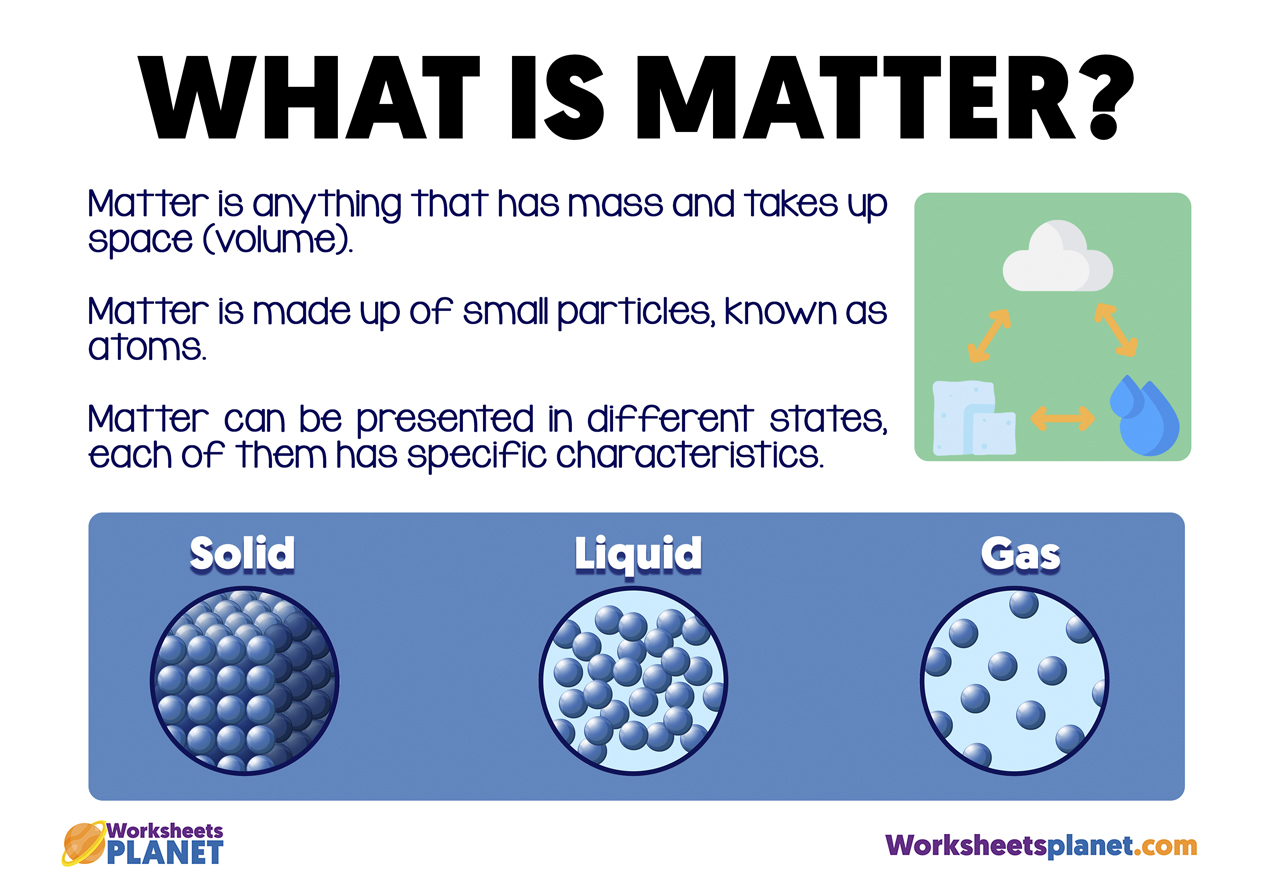
Matter is a substance that has mass and occupies physical space. It consists of various types of particles, each with specific properties such as mass and size. The fundamental building blocks of matter are atoms, which are composed of protons, neutrons, and electrons.
Composition of Matter
At the most basic level, matter is made up of elementary particles known as quarks and leptons. Quarks combine to form protons and neutrons, while leptons include electrons. Atoms are formed when these particles come together in specific arrangements.
- Atoms: The smallest units of matter that retain the properties of an element.
- Molecules: Combinations of two or more atoms bonded together.
- Elements and Compounds: Elements consist of only one type of atom, while compounds are substances formed from two or more different elements.
For example, sodium (Na) and chlorine (Cl) can combine to form sodium chloride (NaCl), commonly known as table salt.
States of Matter
Matter exists in several states based on temperature and pressure conditions:
- Solids: Particles are tightly packed in a fixed arrangement, giving solids a definite shape and volume.
- Liquids: Particles are less tightly packed than in solids, allowing them to flow and take the shape of their container while maintaining a definite volume.
- Gases: Particles are spread out with significant space between them, allowing gases to fill their container completely without a fixed shape or volume.
Other states include plasma (ionized gas with high energy) and Bose-Einstein condensates (formed at near absolute zero temperatures).
Chemical Reactions and Changes in State
Matter can undergo changes through chemical reactions where atoms rearrange to form new substances without altering the nuclei of the atoms involved. Physical changes can also occur when matter transitions between states (e.g., melting, freezing).
- Melting: Solid turns into liquid upon heating.
- Freezing: Liquid turns into solid upon cooling.
- Vaporization: Liquid turns into gas upon heating.
- Condensation: Gas turns into liquid upon cooling.
its incredible that i though this was an easy topic , but indeed it is
ReplyDeleteso everything around us is matter
Delete